🧠 Verified GLP-1 Questions: The Patient Owner’s Manual
Stop guessing. We’ve compiled the complete medical fact-check library on "Food Noise," insurance denials, safety timelines, and the real costs of Wegovy vs. Zepbound.
Compare Providers →Featured Guides
Curated by our Editorial BoardThe Science of the "Radio" in Your Head
Most patients spend decades believing their constant hunger is a character flaw. They are told they simply lack discipline. This video breaks down the neuroscience of "Food Noise"—technically known as aberrant salience.
It explains why the GLP-1 receptor agonist is not a "cheat code" for weight loss, but a corrective lens for a broken signaling system in the hypothalamus. Watch this to understand why "willpower" was never the variable that mattered.

Swipe to see more guides
Explore Other Topics
Deep dive into specific guidesStart Here
Understanding "Food Noise," the biology of GLP-1s, and what to expect in Month 1.
Pricing & Compare
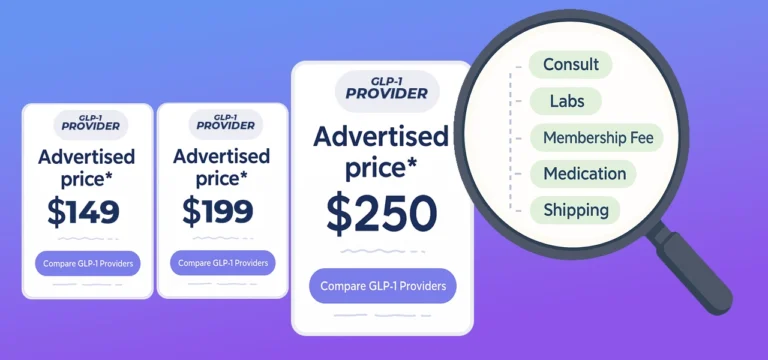
The real cost of Wegovy vs. Zepbound. Hidden fees and insurance copays.
Insurance & Coverage
How to fight a "Prior Auth" denial and check coverage rules.
Safety & Side Effects
Nausea, "Ozempic Face," and long-term risks. Fact vs. Fiction.
Switching & Refills
Finding stock during a shortage and how to safely switch brands.
Brands & Comparisons
Mounjaro vs. Ozempic vs. Wegovy. Head-to-head comparisons.
Swipe to explore topics
Common Questions
What is the difference between "Food Noise" and normal hunger?
Normal hunger is a homeostatic signal: your body needs fuel, you eat, and the signal dissipates. Food Noise is a dysregulated reward signal. It involves planning the next meal while still eating the current one, engaging in mental bargaining over snacks, or feeling a background anxiety about food availability.
Research using brain-computer interfaces indicates that GLP-1 medications like tirzepatide do not just "fill the stomach"; they suppress the signaling in the brain's reward centers. This effectively "turns down the dial" on the noise.
How do I get insurance to cover GLP-1s if I don't have Type 2 Diabetes?
This means you cannot simply ask for the drug. You must provide evidence that you have tried and failed cheaper, preferred agents on the formulary—typically generic medications like Phentermine, Contrave, or Qsymia—for a period of 3 to 6 months. This documentation must be explicit in your medical chart.
Furthermore, you must avoid the "Diagnosis Mismatch." A common error is requesting "Ozempic" (which is FDA-approved only for Type 2 Diabetes) instead of "Wegovy" (approved for obesity).
Is it safe to switch from Wegovy to Zepbound for better results?
However, switching from Wegovy to Zepbound is not a 1:1 conversion. Because the mechanisms differ, patients usually cannot switch directly from a high dose of Wegovy (e.g., 2.4 mg) to a high dose of Zepbound (e.g., 15 mg). Doing so risks severe gastrointestinal distress.
The standard medical protocol often involves a "washout" period of 7-14 days to allow the semaglutide to clear the system, followed by a "reset" at the lowest initiation dose of the new medication (e.g., 2.5 mg Zepbound).