
Weekly Weight-Care Medication Change Questions for Your Clinician


THE BOTTOM LINE
Transitioning from Zepbound (tirzepatide) to Wegovy (semaglutide) requires a mandatory 7-day washout period and a clinical reset to the 0.25 mg initiation dose.1 Direct dose conversion is clinically contraindicated due to distinct receptor mechanisms: Zepbound targets two hormones (GIP/GLP-1) while Wegovy targets one (GLP-1).1 Ignoring the washout risks "stacking" active medication, leading to severe gastrointestinal distress or acute pancreatic problems.1
What This Switching Review Covers
- Why the 7-Day washout period matters
- Why a direct dose match is not clinically safe
- What to expect when restarting at 0.25 mg Wegovy
- How cost and provider access can change during the switch
The Biological Mechanism: Why You Can't "Match" Doses
To understand why a direct switch (e.g., 15 mg Zepbound to 2.4 mg Wegovy) is dangerous, we must look at the receptor biology.1 The most common medical error patients make is assuming that higher milligrams equal higher strength. This logic is flawed because these molecules work differently.1
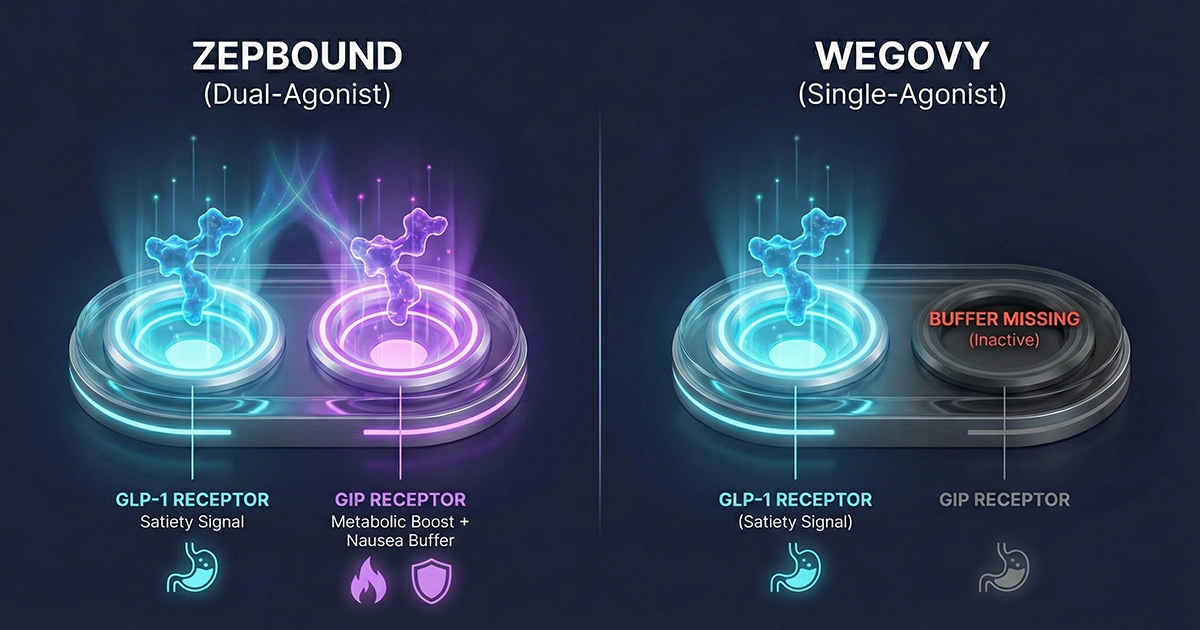
Dual-Agonist vs. Single-Agonist
- Zepbound (Tirzepatide): A Dual-Agonist.12 It mimics GLP-1 (satiety) plus GIP (Glucose-dependent Insulinotropic Polypeptide).1 GIP acts as a metabolic "turbocharger" and, paradoxically, has an anti-emetic (anti-nausea) effect on the central nervous system.12
- Wegovy (Semaglutide): A Single-Agonist.1 It targets only the GLP-1 receptor. While it lacks the GIP component, Wegovy has superior properties for cardiovascular protection in people with a history of cardiovascular disease and is effective in the combined treatment of Type 2 diabetes, obesity, and sleep apnea.13
The "Potency Drop" Warning
When you switch to Wegovy, you lose the GIP component.1 This results in two things:
- Metabolic Efficiency: You lose the secondary lipid metabolism pathway provided by GIP.1
- Nausea Buffer Loss: You lose the anti-nausea protection of GIP as Wegovy slows gastric emptying.1 This is why patients who switch to high-dose Wegovy often report intractable vomiting.1 They are hitting the GLP-1 receptor hard without the GIP buffer they are used to.4
Changing treatment next?
Compare switching support
Coach Claire Says:
You're probably dealing with one of the two "big headaches" of modern weight loss: the pharmacy is out of stock, or your insurance company sent you a letter saying they changed their mind. It's frustrating to find a rhythm with Zepbound only to have to switch gears, but you aren't alone.
Think of Zepbound as a dual-engine jet and Wegovy as a single-engine plane. You can't just swap the fuel mid-flight without landing first.1 But remember the most important part: always check with your healthcare team to keep your plane flying high! Let's walk through the science of the safe switch so you can protect your progress without wrecking your stomach.
The Timeline: The 7-Day Washout Rule
You cannot take a Zepbound shot on Monday and a Wegovy shot on Tuesday. This puts you at risk of stacking, where the peak concentration of both drugs overlaps.1
The Half-Life Calculation
Pen Mechanics: Don't Jam the Wrong Button
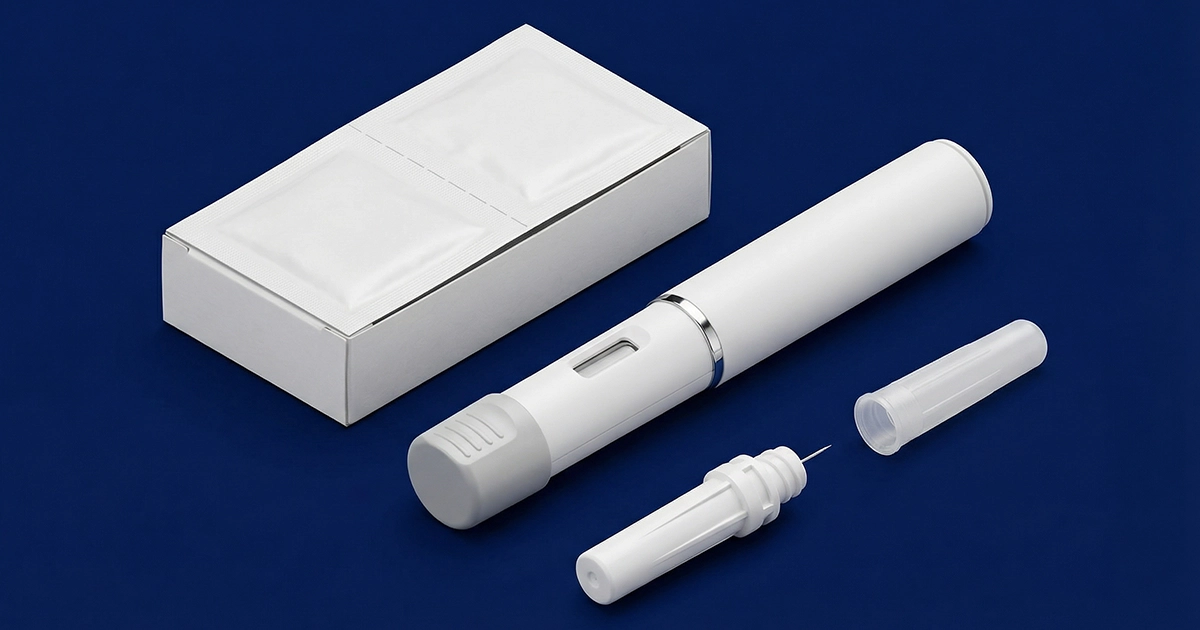
A practical hurdle that trips up many patients is the physical difference in the injection devices. Muscle memory from one device can lead to user error with the other.
Device Awareness:
- Zepbound: Uses a Button-Activated auto-injector.1 You place against skin, unlock, and press the purple button.1 The needle retracts automatically.
- Wegovy (US): Uses a Pressure-Activated auto-injector.1 There is NO BUTTON. You must push the entire pen firmly against the skin to activate it. If you wait for a button press, nothing will happen.1
- Wegovy (International/Select Batches): May come as a "FlexTouch" dial-dose pen, where you must attach a fresh needle tip manually.1
CRITICAL SAFETY: The "Wet Injection" Myth
If you pull away too early, you risk a "Wet Injection" (spilling the drug).1
WARNING: NEVER assume "nothing went in" and never give yourself another dose until you have spoken to your doctor. Improper use leads to over-treatment planning, which could lead to serious adverse effects like severe hypoglycemia.1 If the pen clicked, assume the dose was delivered.1
Patient Scenarios: Managing the Transition
The first week of the switch is the most volatile.1 You are introducing a new chemical entity to a body that has likely been "spoiled" by the anti-nausea effects of GIP.
- Bananas
- Rice (White)1
- Applesauce
- Toast
Avoid high-fat, high-fiber, or spicy foods during this 48-hour window.1 The goal is to minimize gastric workload while the sphincter of Oddi (a valve in the digestive tract) adjusts to the strong GLP-1 signal.1
Cost and Insurance Implications7
The switch is often driven by finances.1 Here is the reality of the market right now.
Safety Warnings & Side Effects
SAFETY WARNING: The "Stacking" Myth
Do not attempt to "use up" your last Zepbound pen mid-week before starting Wegovy. "Stacking" these medications increases the risk of:
Hypoglycemia: Dangerously low blood sugar.1
Gastroparesis: Severe slowing of the stomach, leading to vomiting undigested food days later.1
Thyroid Risks
Both medications carry a boxed warning regarding findings of thyroid C-cell tumors in rodents.1 If you have a personal or family history of Medullary Thyroid Carcinoma (MTC) or Multiple Endocrine Neoplasia syndrome type 2 (MEN 2), you should not take either medication.14 If you or anyone in your family takes a medication for a thyroid problem, be sure to let your provider know.147
FAQ: The Switch Strategy
Can I ever switch back to Zepbound?
Yes. If supply returns or your insurance changes again, you can switch back.1 However, you will likely need to repeat the "start low" care plan discussion with Zepbound (2.5 mg) to re-acclimate your body to the GIP agonist.1
Will I gain weight during the switch?
It is possible to see a temporary plateau or slight regain during the first 8 weeks of Wegovy.1 This is because you are titrating up from a non-therapeutic dose (0.25 mg) while coming off a high dose of Zepbound.1 Trust the process; the weight loss efficacy typically returns once you reach the 1.7 mg or 2.4 mg dose.1
Coach Claire Sign-Off
"I know it feels like a setback to go from a 'high dose' back down to the starter blocks, but think of it like switching from running to swimming.
You're still an athlete, but you need to train different muscles.1 This reset protects your body and ensures you can stay on the medication long-term without major issues. Be patient with the 'food noise' in those first few weeks: it's just your body adjusting to the new co-pilot. You've got this!"
Coach Claire's Cheat Sheet
Quick definitions used in this article.
References
- Almandoz JP, Lingvay I, Morales J, Campos C. Switching Between Glucagon-Like Peptide-1 Receptor Agonists: Rationale and Practical Guidance. Clinical Diabetes. 2020 Oct;38(4):390-402. Available at: diabetesjournals.org [top]
- Collins L, Costello RA. Glucagon-like Peptide-1 Receptor Agonists. [Updated 2023]. In: StatPearls [Internet]. Treasure Island (FL): StatPearls Publishing; 2023. Available at: ncbi.nlm.nih.gov [top]
- Novo Nordisk. Wegovy? (semaglutide) injection Prescribing Information. Plainsboro, NJ: Novo Nordisk Inc.; 2024. Available at: novo-pi.com [top]
- Borner T, et al. GIP Receptor Agonism Attenuates GLP-1 Receptor Agonist-Induced Nausea and Emesis in Preclinical Models. Diabetes. 2021;70(11):2545-2553. Available at: diabetesjournals.org [top]
- Eli Lilly and Company. Zepbound? (tirzepatide) injection Prescribing Information. Indianapolis, IN: Eli Lilly and Company; 2023. Available at: pi.lilly.com [top]
- Novo Nordisk. Treatment Planning Schedule for Wegovy. Wegovy.com. 2023. Available at: wegovy.com [top]
- National Institutes of Health. Side Effects of GLP-1 Agonists. MedlinePlus. 2024. Available at: medlineplus.gov [top]