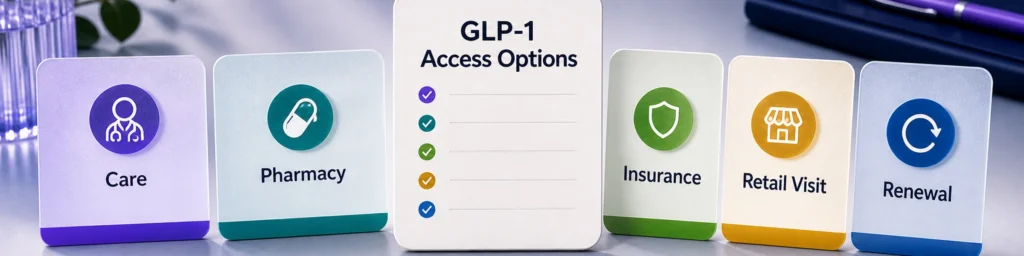
GLP-1 Access Options Explained

Edited by Ryan Lafayette. This guide reports public details only and is not medical advice.
Quick answer
The different options across GLP-1 providers can mean very different things. Some include a clinician visit. Some help fill medication after you already have a prescription. Some focus on insurance paperwork. Some may only fit people who are already taking a GLP-1 and need a renewal review.
- Good fit: You want plain-English help deciding which kind of provider option matches your next step.
- Be careful: A pharmacy option, virtual visit, insurance-focused program, and renewal review are not interchangeable.
- Look wider: If you are not sure what matters first, compare broadly after you separate care, medication filling, insurance help, retail visits, and renewal.
The different options across GLP-1 providers can cover very different needs. Use this guide to decide what matters first before you compare.
This guide uses public examples to explain comparison questions. It is not medical, insurance, pharmacy, or pricing advice. Review how FindMyGLP1 verifies public details at How We Verify
Compare GLP-1 Access Options by Your Highest Priority
Avoid overwhelm by asking one practical question first: "What must be handled before anything else?" Your answer changes which GLP-1 access options are worth comparing.
- Need someone to decide whether treatment is appropriate? Start with clinical care.
- Already have a prescription? Start with medication filling, pharmacy choice, delivery, or pickup.
- Hoping to use insurance? Start with coverage rules, prior authorization, and paperwork support.
- Want a retail visit? Start by separating the visit from the medication fill.
- Already taking a GLP-1? Start with renewal rules, records, dose history, and refill timing.
Those are different needs. A low medication price does not mean prescribing care is included. A virtual visit price does not mean medication is included. An insurance-focused program can help with paperwork, but it cannot promise plan approval. A renewal option may not fit someone starting from scratch.
Five Questions to Ask Before You Compare
Use this check before treating two visible prices as the same kind of provider option.
| Start here | What to check |
|---|---|
| Need a prescription? | Look for clinical evaluation, visit requirements, follow-up, and pharmacy choice. |
| Already have one? | A pharmacy or manufacturer-linked option may help with filling, delivery, or pickup. |
| Using insurance? | Check who handles paperwork and remember that the plan decides benefits and final cost. |
| Want a retail visit? | Separate the visit price from medication, labs, pharmacy checkout, and refill rules. |
| Need renewal? | Confirm whether the option is for people already taking a GLP-1 and what records are required. |
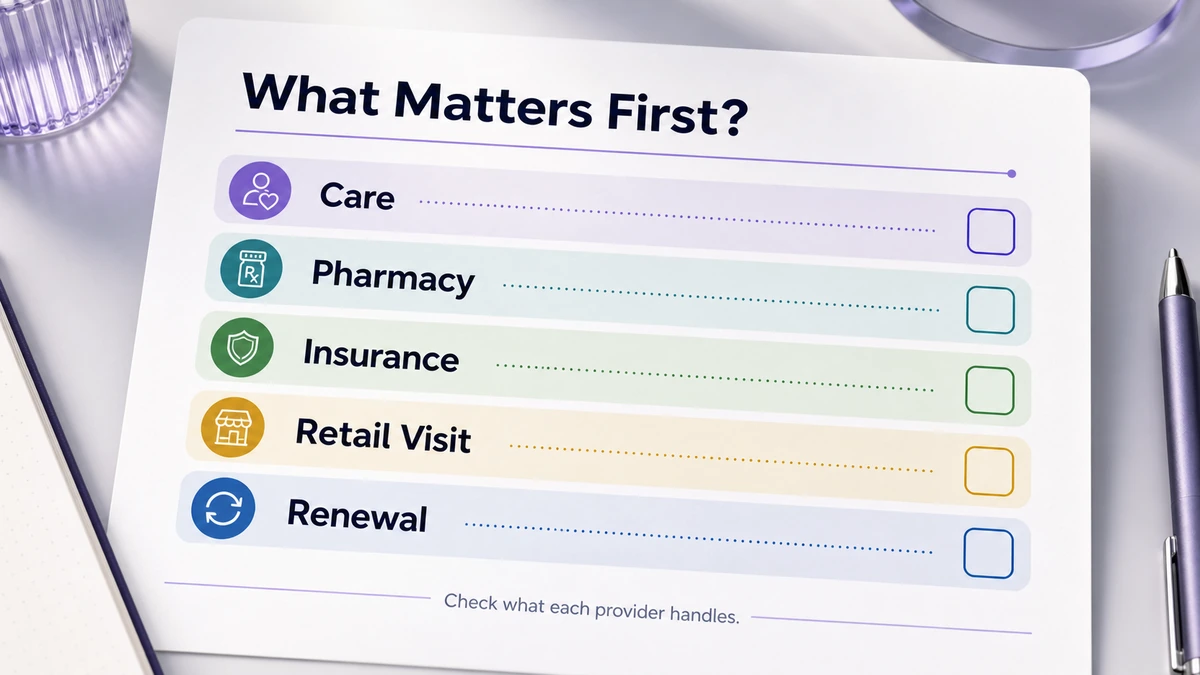
This figure separates common GLP-1 provider questions. It does not prove price, approval, coverage, stock, eligibility, delivery, or renewal.
Quick Check Before Comparing
When two GLP-1 provider options look similar, ask what each one actually handles: care, medication filling, insurance paperwork, a retail visit, or renewal.
Manufacturer Service, Retail Pharmacy Option, or Telehealth Provider Program?
These labels can sound like versions of the same thing, but they usually solve different jobs. Before comparing prices, decide whether you need care, a prescription fill, brand-specific savings, insurance paperwork, or a renewal review.
Use this table to separate the main job from the pieces that may still be separate.
| Option type | Usually helps with | Still check |
|---|---|---|
| Manufacturer service | Brand-specific savings, pharmacy setup, delivery, pickup, or prescription-routing details after prescription requirements are met. | Whether prescribing care, follow-up, eligibility, fees, and refill timing are separate. |
| Retail pharmacy option | Medication filling, pickup, delivery, or a retail virtual-care visit that may be separate from the pharmacy checkout. | Whether you need an outside prescriber, what the visit costs, whether medication is in stock, and where the service is available. |
| Telehealth provider program | Clinical evaluation, prescribing steps, follow-up rules, insurance support when listed, and medication choice when appropriate. | Whether medication, labs, membership, pharmacy choice, refills, and prior authorization work are included or separate. |
This table explains common jobs. It does not prove price, coverage, prescribing, stock, eligibility, delivery, or availability.
Do not assume manufacturer support is medical care. Do not assume a pharmacy listing is a full provider program. A telehealth program can include medical care but may still leave the medicine, labs, pharmacy checkout, or insurance decision separate.
Access-option details to check
Use these pages to see what current public pages say an option appears to do, what may depend elsewhere, and what to verify before payment.
These pages summarize public details. They are not rankings, endorsements, or medical recommendations, and they stay separate from provider outbound links.
If You Need Prescribing Care
If you do not already have a prescription, look for an option that includes clinical evaluation. That could be an online program, a retail virtual-care visit, a primary-care clinician, an obesity medicine clinician, or another licensed provider.
If the open question is how to get evaluated, use the GLP-1 prescription guide to separate intake, insurance or self-pay, telehealth, and pharmacy fulfillment before comparing providers.
The practical check is bigger than "Can this provider prescribe?" Before choosing, look for:
- Intake review and visit requirements
- Follow-up expectations
- Lab expectations, if the provider lists them
- What happens if the requested medication is not appropriate
- Whether insurance paperwork is included or separate
- Whether the prescription can go to your chosen pharmacy
This is where many comparisons get confusing. A provider can offer care without including medication. A pharmacy can help with a fill without being the clinician who evaluates you.
GLP-1 Pharmacy vs Telehealth Is About What Is Included
If you are comparing GLP-1 pharmacy vs telehealth, do not treat it as a single winner-take-all choice. First check what part of the process you need next.
Manufacturer services can be useful when you already have a prescription or your clinician can send one. LillyDirect and NovoCare Pharmacy are useful examples to check because manufacturer pages may describe brand-specific medication filling, delivery, pickup, savings, or eligibility details.
That does not make them the same as a prescribing visit. If you are looking at a manufacturer pharmacy page, use the source to check what that page actually handles before you compare it as care:
- Whether it handles medication filling, delivery, or pharmacy setup
- Whether the manufacturer page is only a fill-and-delivery step
- Whether clinical care is included or separate
- Whether records review, insurance work, or follow-up care are included
If You Only Want Brand-Name Medication
If your line is brand-name medicine only, start by checking the exact medication name instead of the active ingredient alone. Wegovy and Ozempic are semaglutide brands. Zepbound and Mounjaro are tirzepatide brands. A listing for compounded semaglutide or compounded tirzepatide belongs in a different category, not a generic version of those brands.
Use three checks before you compare:
- Does the page name the brand and form, such as Wegovy, Ozempic, Zepbound, or Mounjaro?
- Does the price describe the medicine, visit, membership, pharmacy checkout, or savings eligibility?
- If a provider offers both brand and compounded choices, can you choose the brand-name option before you pay?
FDA says compounded drugs are not FDA-approved. FDA-approved generic drugs go through a separate approval process, so do not treat a compounded listing as a generic Wegovy or Zepbound. That does not decide which treatment is right for you, but it does mean brand-name medicine and compounded listings should stay separate when you compare options.
If You Want a Retail Visit and Local Pharmacy Choice
Retail virtual-care options can sit between a traditional telehealth program and a local pharmacy fill. Walgreens Weight Management is a useful public example to check because its materials may show how the visit, medication, and pharmacy steps are handled separately.
That separation matters:
- A visit price tells you what the appointment may cost.
- It does not automatically tell you the medication price.
- It does not prove a prescription will be written.
- It does not prove a savings offer applies.
- It does not prove the medication is in stock.
Also check where the option is available. A retail virtual-care service may list state availability, visit hours, follow-up expectations, lab requirements, or refill rules. Those details can decide whether the option is realistic even when the headline price looks simple.
If Insurance Paperwork Is the Hard Part
If coverage is the hardest part, look for GLP-1 insurance help from a clinical option rather than a medication-filling option. Form Health is a useful public example to check for current insurance billing, prior authorization support, medication policy, and clinician or dietitian care details.
Insurance help does not mean guaranteed coverage. Your plan can still decide:
- Whether the medication is covered
- Whether prior authorization is required
- What documentation is needed
- Whether the pharmacy can fill the prescription under your plan
- What you owe through copays, deductibles, or pharmacy rules
This is also why a program can be useful even when the final medication price is unknown. If the public source says the cost depends on your plan, the honest next step is to check coverage details, not force the option into a medication price comparison.
If You Already Take a GLP-1 and Need Renewal
If you already take a GLP-1 and need renewal, separate that from starting treatment. One Medical + Amazon Pharmacy is a useful public example to check because its GLP-1 renewal materials may apply only to people with recent GLP-1 use who meet current renewal conditions.
That makes the option relevant for experienced users, but it should not be treated as a general first-time program unless the current source says so. Renewal rules can exclude people who need dose changes, prior authorization help, compounded medication renewal, pregnancy-related care, or a full new evaluation.
Before comparing renewal options, gather:
- Your current medication and dose
- Pharmacy information
- Recent visit notes, if available
- Recent labs, if available
- Insurance paperwork
- Timing for your next refill
Why the Compare Tool Includes Public Examples
Some providers in the Compare Tool are paid partners. We also include public examples when their details help readers compare real choices.
That is why manufacturer services, retail virtual-care options, insurance-focused care, and renewal options can appear beside paid provider programs. The point is not to say one type is always better. The point is to show the real set of choices people compare.
Use public examples as comparison context, not as shortcuts. They help show what manufacturer support, a retail visit, insurance-focused program, or renewal review may include or leave out.
What to Check Before Choosing
Use the same checklist for every option:
- Does this option include prescribing care, or does it require an outside prescription?
- What medication and format does it discuss?
- Is the visible price for medication, a visit, a care plan, renewal, or something else?
- Does insurance matter, and who handles the paperwork?
- Where is the option available?
- What follow-up or refill rules apply?
- Can the prescription go to your chosen pharmacy?
- Are delivery, pickup, taxes, labs, or pharmacy checkout details separate?
If one of those answers is missing, that does not automatically make the option bad. It means you should treat the missing answer as unknown until the provider or pharmacy source makes it clear.
Use the Compare Tool for Current Options
Use the Compare Tool after you know which priority matters most. You can start broadly, or narrow by medication, format, insurance support, or where an option is available.
Helpful starting points:
FAQ
Is a manufacturer service the same as telehealth care?
No. Manufacturer support may help with savings, pharmacy setup, filling, or delivery after a prescription. It is not the same as a prescribing visit unless the source clearly says clinical care is included.
Is the cheapest visible number always the best comparison point?
No. A visible number may describe only medication, only a visit, only a care plan, or only a renewal appointment. Check what is included before comparing it with a full program price.
Why does the Compare Tool include public examples?
Some public options help shoppers understand the real market. Including them beside paid partners can make the comparison more useful, as long as public details are checked and missing details stay marked as unknown.
References
- FindMyGLP1 Compare Tool
- FindMyGLP1 How We Verify
- Zepbound Savings Options
- NovoCare Wegovy savings and home delivery
- Walgreens Weight Management
- Form Health virtual obesity medicine clinic
- Amazon One Medical GLP-1 prescription renewal
- FDA: Concerns with unapproved GLP-1 drugs used for weight loss
- FDA: Compounding and the FDA questions and answers
Start Quiz
Find your best GLP-1 match
What should the Compare Tool help you check first?
Choosing a provider next?
Check provider options